I. Introduction: The Billion-Dollar Question
If you’ve spent any time sourcing stainless steel wire, you’ve probably typed some version of this into a search bar at 11 p.m.: “What’s the actual difference between 304 and 316?” It’s the single most common question in the industry, and for good reason — get the grade wrong, and you’re looking at premature corrosion, failed welds, or a project that doesn’t survive its first coastal storm.
Stainless steel wire has come a long way from its origins as a purely utilitarian material. Today it appears in cable-net facades, surgical instruments that sit inside the body for years, and salt-resistant architectural balustrades. That range from structural workhorse to precision medical component is exactly why choosing the right stainless steel wire isn’t a commodity decision anymore. It’s an engineering one.
This guide gives buyers, specifiers, and fabricators a practical roadmap for balancing performance, cost, and environmental responsibility across every project. Whether you’re speccing wire for a new build or auditing a supplier relationship, consider this your reference point.
II. 304 vs. 316: Decoding the Best Choice for Your Application
Grade 304 — The Standard
Grade 304 is the workhorse of the austenitic stainless family, and it’s popular for a simple reason: it does the job well for a huge range of everyday applications without demanding a premium. Fresh water systems, kitchen appliances, facades, and general fabrication favor 304 for its corrosion resistance, formability, and affordable weldability.
Grade 316 — The Specialist
Grade 316 looks almost identical to 304 on a spec sheet, but one addition changes everything: molybdenum. That single alloying element is what gives 316 its reputation as the “marine-grade” stainless steel. Molybdenum significantly boosts resistance to pitting and crevice corrosion the damage chlorides cause in seawater, de-icing salts, and many industrial and acidic environments.
Same Look, Different Survival Odds
Here’s the part that trips up a lot of buyers: 304 and 316 stainless steel wire can be visually indistinguishable. Same shine, same handling, same general feel on a spool. But their chemical profiles tell two very different stories once they’re exposed to harsh conditions. Choosing based on appearance alone is one of the most expensive mistakes a buyer can make.
Comparison: 304 vs. 316 Chemical Composition (typical ranges)
| Element | 304 | 316 |
|---|---|---|
| Carbon (C) | ≤ 0.08% | ≤ 0.08% |
| Chromium (Cr) | 18.0–20.0% | 16.0–18.0% |
| Nickel (Ni) | 8.0–10.5% | 10.0–14.0% |
| Molybdenum (Mo) | — | 2.0–3.0% |
Rule of thumb: If the stainless steel wire will ever see saltwater, coastal air, chlorides, or acidic process chemicals, spec 316. If it’s staying in a dry, indoor, or low-chloride environment, 304 will usually do the job for less.
III. Understanding the Annealing Process: Why Softness Matters
What Is Annealing?
Annealing is a controlled heat treatment applied to wire after it’s drawn down to size. Wire drawing work-hardens the metal, making it stiff and brittle — great for some uses, terrible for others. Annealing reverses that hardening, restoring flexibility and ductility so the stainless steel wire can be bent, formed, or tied without cracking.
The “Condition A” Advantage
In supplier specs, you’ll often see wire listed as Condition A — Annealed. This suits applications needing intricate bending, weaving, or tying — wire mesh, fine jewelry-adjacent work, or on-site fencing. Annealed wire trades some tensile strength for workability, and in these applications, that trade is exactly what you want.
How the Microstructure Changes
The process happens in three stages:
- Heating: The process heats the wire to roughly 1900°F–2050°F (1040°C–1120°C), high enough to reorganize its crystal structure
- Soaking: The wire soaks at that temperature long enough to reach thermal equilibrium throughout the coil, ensuring consistent quality from outer wraps to core.
- Cooling: Controlled cooling locks in a uniform, refined grain structure — the microscopic reason annealed wire bends smoothly instead of snapping.
Understanding this process matters even without touching a furnace — it explains why “soft” and “hard” grades behave differently.
IV. Performance Benchmarks: ASTM A580 and Mechanical Specs
The Gold Standard
When it comes to stainless steel wire, ASTM A580/A580M is the specification that everything else gets measured against. It defines the chemical and mechanical requirements for stainless and heat-resisting steel wire across the common grades, and it’s the reference point most reputable mills and buyers use to keep everyone speaking the same language.
Tensile and Yield Strength
Typical benchmarks for annealed 304L/316L wire fall in the range of roughly 70–75 ksi tensile strength, though exact numbers shift depending on diameter, condition, and finish. These figures matter because they tell you, in hard numbers, whether the stainless steel wire can handle the structural loads your application will actually put on it — not just whether it “looks” strong enough.
Typical Mechanical Requirements by Family
| Steel Family | Example Grades | General Characteristic |
|---|---|---|
| Austenitic | 304, 304L, 316, 316L | Non-magnetic, excellent corrosion resistance, good ductility when annealed |
| Ferritic | 430 | Magnetic, moderate corrosion resistance, lower cost |
| Martensitic | 410, 420 | Magnetic, heat-treatable for high hardness, used where wear resistance matters |
Surface Finishes
Finish isn’t just cosmetic — it affects friction, cleanability, and corrosion resistance:
- Bright finish: Highly reflective, smooth surface, often preferred for visible architectural or decorative work.
- Matt (dull) finish: Lower reflectivity, frequently used where glare or fingerprinting is a concern.
- Coated finishes: Applied for specific industrial needs, such as added lubricity for high-speed forming or extra corrosion protection.
V. Fabrication and Joining: From Welding to Mechanical Fastening
Professional Welding Techniques
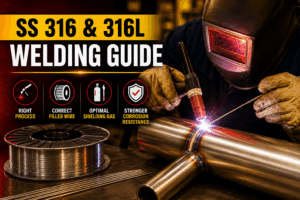
MIG vs. TIG : MIG welding, which uses a continuously fed consumable wire electrode, is generally faster and well-suited to thicker sections and higher-volume work. TIG welding uses a non-consumable tungsten electrode and gives the operator much finer control, making it the preferred method for precision joints, thin gauges, and applications where weld appearance matters.
Spot and Seam Welding For fine meshes and lighter gauge assemblies, spot welding (joining at discrete points) and seam welding (a continuous overlapping series of spot welds) are the standard techniques for tacking wires together quickly and consistently.
Mechanical Solutions
Not every joint needs heat. “C” clips paired with closing pliers are a fast, reliable way to join stainless steel wire for fencing, panel work, and other applications where a mechanical fastening is preferable to welding — faster installation, no heat-affected zone, and easy field repairs.
The Filler Metal Pitfall
Here’s a mistake worth flagging clearly: using 309L filler metal as a stand-in for 316 base metal. It’s a tempting shortcut because 309L is a versatile, widely stocked filler — but it doesn’t contain molybdenum. Weld a 316 assembly with 309L filler and you’ll get a joint that looks fine on day one but lacks the very corrosion resistance you specced 316 for in the first place. Always match filler chemistry to base metal chemistry, especially when molybdenum-bearing grades are involved.
Quick Welding Method Checklist
- Thin gauge, high-precision work → TIG
- Thicker sections, higher volume → MIG
- Fine mesh, repetitive joints → Spot/seam welding
- Field assembly, fencing, panels → Mechanical “C” clips
- Any 316/316L joint → Confirm molybdenum-bearing filler metal
VI. Global Applications: Beyond the Basics
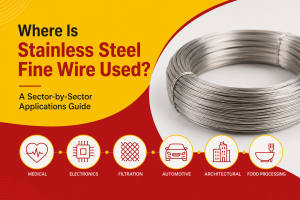
Architecture: Sleek stainless steel wire rope railings, green wall trellis systems, and suspended walkway cabling all rely on the material’s combination of strength, corrosion resistance, and clean aesthetic.
Industrial Engineering: High-durability springs, filtration mesh, and conveyor belting all depend on stainless steel wire’s fatigue resistance and ability to hold up under repeated mechanical stress.
Medical Innovation: Grade 316L — the low-carbon version of 316 — plays a critical role in pacemaker components and surgical instruments, largely thanks to its biocompatibility and resistance to corrosion inside the body.
From an airplane engine component to a coastal stainless steel wire balustrade, the same base material is doing fundamentally different jobs — which is exactly why grade and spec selection deserve real attention rather than a default choice.
VII. The Future of Manufacturing: Green Steel and Sustainability
Sustainability isn’t a side conversation in stainless steel anymore — it’s becoming a purchasing criterion. India’s steel industry has articulated a “Near Zero Initiative” alongside ambitious green steel production targets, with figures like 300 million tonnes of production by 2030 circulating as part of the broader push toward decarbonized manufacturing.
The underlying advantage stainless steel has here is real: it is 100% recyclable without any loss of quality, meaning scrap can be reintroduced into the production cycle indefinitely — a genuine circular economy story, not just marketing language.
When evaluating a manufacturer’s environmental credentials, look for concrete practices rather than broad claims: meaningful scrap recycling rates, energy-optimized furnace and rolling operations, and transparency about emissions reduction targets. These are the details that separate a genuinely green supplier from one that’s simply using the word.
VIII. Handling, Storage, and Care
Prevention is key. Bare hands leave oils and fingerprints on stainless steel surfaces, and over time those residues can contribute to surface staining or localized corrosion. Gloves during handling are a small habit that prevents an avoidable problem.
Storage best practices. Keep stainless steel wire and coils in dry, clean, well-ventilated areas, away from moisture, chlorides, and other corrosive chemicals. Cross-contamination from carbon steel tools or storage racks is another common — and preventable — cause of surface rust on stainless material.
Watch for tea staining. In coastal or high-humidity environments, keep an eye out for the light brown surface discoloration known as “tea staining.” It’s largely cosmetic rather than structural, but routine inspection and cleaning go a long way toward keeping installed stainless steel wire looking as good as it performs.
IX. Conclusion: The Buyer’s Checklist
At the end of the day, the 304-vs-316 decision comes down to a simple trade-off: lower upfront cost (304) versus greater lifetime durability in harsh environments (316). Get that call right, and the rest of your specification — condition, finish, mechanical requirements — falls into place around it.
Before you place an order, run through this checklist:
- Specific ASTM designation and revision date (e.g., ASTM A580/A580M)
- Type / UNS designation (e.g., S30400 for 304, S31600 for 316)
- Condition (e.g., Condition A – Annealed)
- Dimensions, tolerances, and coil weight requirements
- Surface finish (Bright, Matt, or Coated)
- Confirmed filler metal compatibility if welding is involved
Locking these details down before you order isn’t just paperwork — it’s the difference between a wire that performs exactly as specified and one that becomes a callback six months into a project.
Ready to move from spec sheet to sourcing? Consult with established global suppliers Ambica Steels to align your project requirements with the right grade, condition, and sustainability profile for your application. A conversation with an experienced supplier before you finalize your order is almost always cheaper than a correction after the fact.