The quality of every stainless steel fastener — every bolt, screw, nut, rivet, and stud that holds machinery, infrastructure, and equipment together — begins long before the forming machine starts. It begins with the wire. Selecting the right stainless steel cold heading wire is one of the most consequential decisions a fastener manufacturer or procurement team will make. The wrong choice leads to cracking, inconsistent dimensions, accelerated die wear, and ultimately, rejected parts. The right choice supports smooth production, reliable mechanical performance, and long-term cost efficiency.
This guide gives engineers, production managers, and buyers a clear, practical framework for evaluating and sourcing stainless steel cold heading wire — matched to their application, their machines, and the final performance requirements of the stainless steel fasteners they manufacture.
What Is Stainless Steel Cold Heading Wire — and Why Does It Matter for Fastener Production?
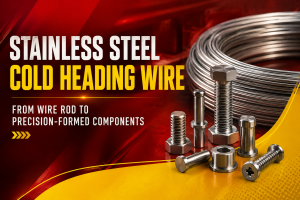
Cold heading cuts wire to length and shapes it at room temperature using high-pressure dies to produce fasteners and precision components. The process uses no heat, so the wire itself must carry every property that clean, repeatable forming demands — ductility, surface integrity, dimensional consistency, and the right mechanical strength range.
Stainless steel cold heading wire is a purpose-built product. Manufacturers produce it through a controlled sequence of hot rolling, controlled cooling, wire drawing, and annealing — each step designed to build the specific microstructure and surface condition that cold heading demands. It is not general-purpose wire simply drawn down in diameter.
For SS fastener manufacturers, this wire directly determines forming quality, scrap rate, and final fastener properties
The Four Key Selection Criteria for Cold Heading Wire
When evaluating cold heading wire for fastener production, four parameters define suitability:
1. Grade — Matching the Alloy to the Application
The stainless steel grade determines corrosion resistance, strength, formability, and end-use performance of the stainless steel fasteners produced. The most commonly used grades in cold heading include:
AISI 302HQ (XM7) This is the preferred grade for cold heading in high-volume fastener production. Its modified chemistry — lower carbon, higher copper — gives it superior cold forming characteristics with reduced work hardening. It is the industry standard for screws, bolts, and socket head cap screws where dimensional precision and high forming speed matter most.
AISI 304 / 304L The workhorse of the stainless steel family. Grade 304 cold heading wire is widely used for general-purpose SS fasteners in construction, automotive, and industrial applications. It offers excellent corrosion resistance in most indoor and mild outdoor environments. 304L has lower carbon, reducing the risk of sensitisation during any heat treatment following forming.
AISI 316 / 316L The preferred choice when fasteners will be exposed to chlorides, marine environments, or chemical processing conditions. The addition of molybdenum gives grade 316 superior corrosion resistance compared to 304. 316L cold heading wire is specified for fasteners used in marine hardware, food processing equipment, pharmaceutical machinery, and offshore structures.
AISI 410 A martensitic grade offering higher strength than austenitic options. Used where tensile strength requirements exceed what 304 or 316 can deliver, particularly in applications where magnetic response is acceptable. Selected for self-tapping screws and certain industrial fasteners.
AISI 430L / 434 Ferritic grades used where cost sensitivity is high and corrosion demands are moderate. Suitable for interior architectural fasteners and consumer goods.
The grade selection should begin with the end-use environment and mechanical performance specification of the stainless steel fastener, working backward to identify the appropriate cold heading wire grade.
2. Surface Condition — The Foundation of Die Life and Forming Quality
Surface condition is one of the most underappreciated factors in cold heading wire selection, yet it directly affects tool life, lubrication efficiency, and forming success rate.
Bright Drawn Finish Wire drawn to a smooth, bright surface with minimal scale. This is suitable for standard forming speeds and applications where a clean, consistent surface finish is required on the finished SS fasteners.
Soap-Coated or Lime-Coated Finish A lubricant coating applied during wire drawing that remains on the surface and significantly reduces friction during forming. This is the preferred choice for high-speed, multi-station cold heading machines where die temperature and forming pressure are elevated. Soap-coated cold heading wire extends die life and reduces the frequency of lubrication interruptions.
Phosphate + Soap Coating Used for demanding multi-stroke forming sequences. The phosphate layer provides an excellent base for soap lubrication, enabling extreme forming without surface galling or wire-to-die adhesion.
Buyers sourcing stainless steel cold heading wire for high-volume, automated production lines must specify surface condition carefully — it is not a minor detail. A mismatch between surface finish and machine requirements is a common but avoidable cause of production inefficiency.
3. Mechanical Properties — Balancing Formability and Strength
The mechanical specification of cold heading wire must balance two competing demands: the wire must be soft enough to deform cleanly during forming, but must deliver the required mechanical properties in the finished stainless steel fastener after forming and any subsequent heat treatment.
Key mechanical parameters to specify when ordering cold heading wire include:
Suppliers typically deliver cold heading wire for standard fastener applications in the 650–900 MPa tensile strength range for austenitic grades in the annealed condition. Wire supplied too hard will crack during forming; wire supplied too soft may not achieve the final fastener strength after thread rolling and any post-forming heat treatment.
Elongation Higher elongation values indicate better ductility and formability. Minimum elongation values for cold heading wire are typically 40–50% for austenitic grades.
Hardness Vickers or Rockwell B hardness is used to verify the annealed condition. Consistent hardness across a coil — and between coils from the same order — is essential for predictable, repeatable forming.
Reduction in Area This parameter reflects how much the wire can be deformed before failure. It is particularly important for multi-stage forming and upset ratios above 2:1.
Experienced cold heading wire manufacturers provide Mill Test Certificates (MTC, EN 10204 3.1) with each shipment confirming that the supplied wire meets specified mechanical parameters.
4. Dimensional Tolerance — Precision That Protects Your Process
Dimensional accuracy of the wire — diameter and out-of-roundness — has a direct impact on the consistency of finished SS fasteners and the longevity of feeding and cutting components on cold heading machines.
Cold heading wire for high-precision applications should meet tight dimensional tolerances, typically ±0.02 mm to ±0.05 mm depending on the diameter range and application. Poor dimensional control causes:
- Wire feeding jams in automated machines
- Inconsistent blank weights leading to incomplete or overfilled forming cavities
- Dimensional variation in finished fastener head geometry
Reliable cold heading wire manufacturers invest in precision drawing equipment and online gauging systems to maintain tight, consistent dimensional tolerances across entire coil lengths and across production batches.
Matching Stainless Steel Cold Heading Wire Grade to Fastener Type — A Practical Reference
| Fastener Type | Recommended Grade | Key Requirement |
|---|---|---|
| Standard bolts & screws | 302HQ / 304 | High formability, volume production |
| Marine & offshore fasteners | 316 / 316L | Chloride corrosion resistance |
| Food equipment fasteners | 316L | Hygiene + corrosion resistance |
| High-strength industrial bolts | 410 | Elevated tensile strength |
| Architectural interior fasteners | 430L | Cost efficiency, mild environment |
| Aerospace precision components | 304 / 316 custom spec | Tight mechanical tolerances |
This reference is a starting point. Final grade selection should always be validated against the operating environment, applicable standards, and the forming sequence being used.
What to Look For in Stainless Steel Cold Heading Wire Manufacturers
Sourcing decisions for Stainless Steel cold heading wire go beyond price and lead time. The reliability and technical capability of the manufacturer directly determines the consistency of your production process.
When evaluating cold heading wire manufacturers, consider the following:
Controlled Metallurgy and Heat Treatment Premium manufacturers control the annealing process precisely — not just to achieve target mechanical properties but to ensure uniformity within coils. Variability within a single coil is as damaging as batch-to-batch variation.
Surface Inspection and Eddy Current Testing Subsurface defects are invisible to the naked eye but create cracks and surface breaks during cold heading. Reputable suppliers perform eddy current or other non-destructive testing to detect internal inclusions or seams before dispatch.
Chemical Analysis and Traceability Each batch should be accompanied by a full chemical analysis certificate confirming grade composition. Heat traceability is essential for aerospace, medical, and structural fastener applications.
Grade and Size Range A technically capable supplier will offer the full range of grades used in fastener production — from 302HQ and 304 through 316L, 410, and specialty grades — across a broad diameter range. This allows manufacturers to consolidate procurement without compromising specification.
Packaging Suited to Automated Feeding Cold heading wire is typically supplied in coils, spools, or payoff packs. The packaging must support continuous, tangle-free feeding into automated machines without deforming the wire surface. Discuss packaging requirements with your supplier before placing orders.
Consistent Lead Times and Stock Availability Production disruptions caused by delayed wire deliveries are costly. Established manufacturers with adequate warehouse stock and reliable logistics infrastructure protect your production schedule.
Common Mistakes When Sourcing Stainless Steel Cold Heading Wire for SS Fasteners
Even experienced procurement teams occasionally make avoidable errors when sourcing stainless steel cold heading wire. The most common include:
Substituting grades without mechanical validation. Switching from 302HQ to 304 may appear equivalent, but the work hardening behavior differs. Run trials before committing to a substitution in production.
Ignoring surface finish specifications. Ordering wire without specifying coating type and surface finish often results in receiving material that requires additional lubrication or causes higher die wear than expected.
Evaluating price in isolation. Wire that costs less per kilogram but causes 15% higher scrap, more frequent die changes, and unplanned stoppages is not cost-effective. Total cost of ownership is the correct metric.
Accepting inconsistent batch quality from suppliers. One acceptable delivery does not guarantee the next. Request quality data from multiple batches and ask for references from similar fastener manufacturing applications before committing to a long-term supplier.
Why Indian Fastener Manufacturers Are Increasing Focus on Stainless Steel Cold Heading Wire Quality
India’s stainless steel fastener manufacturing sector has grown significantly, with demand from automotive, infrastructure, renewable energy, and defence sectors rising steadily. As export markets become more accessible and quality standards tighten, fastener producers are under increasing pressure to demonstrate consistent mechanical performance and dimensional precision.
This shift has elevated the importance of sourcing high-quality stainless steel cold heading wire from established cold heading wire manufacturers rather than commodity wire from general suppliers. The distinction between purpose-built cold heading wire and generic wire becomes clear the moment production runs begin — in fewer rejects, longer die life, and more reliable machine performance.
Ambica Steels India Limited supplies stainless steel cold heading wire across grades including 302HQ, 304, 304L, 316, 316L, 410, and 430L, in diameters from 0.8 mm to 16.0 mm with tight tolerances, controlled annealing, and full ASTM A493 compliance. Ambica Steels supports every product with Mill Test Certificates to EN 10204 3.1 and supplies fastener manufacturers across India and internationally.
Conclusion
Selecting the right stainless steel cold heading wire is a decision that touches every stage of fastener manufacturing — from machine setup and forming efficiency to final fastener quality and end-user performance. A clear, structured approach to grade selection, surface condition, mechanical specification, and supplier evaluation eliminates the guesswork and creates a reliable, repeatable production foundation.
Consistently excellent raw material builds the best SS fasteners and stainless steel fasteners. And consistent raw material comes from choosing the right cold heading wire manufacturers — ones with the technical capability, quality systems, and supply reliability to support your production requirements over the long term.
If you are looking for cold heading wire that meets your specification and supports your fastener production targets, explore Ambica Steels’ stainless steel cold heading wire range or get in touch with our technical team for grade recommendations and a quote.