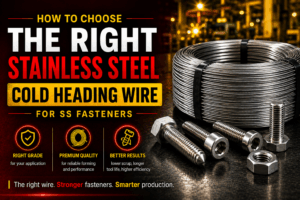
A finished stainless steel fastener may look simple, but its dimensional accuracy, surface quality and forming reliability are influenced by what happened to the steel long before it entered the cold-heading machine.
That is why stainless steel cold heading wire should be viewed as an engineered input material rather than simply stainless steel wire supplied in a particular diameter. Its chemical condition, internal cleanliness, grain structure, surface condition, dimensional consistency and response to deformation all influence what happens when the wire is cut, upset, extruded or formed.
For manufacturers producing bolts, screws, rivets, pins, bushings and miniature precision components, the relationship between wire manufacturing and forming performance is particularly important. A wire that is well prepared for cold forming behaves predictably through successive deformation stages. A wire with inconsistent metallurgical or dimensional characteristics introduces variability that appears only after the component is formed.
Understanding that journey—from wire rod to finished component—provides a clearer view of why manufacturing control matters.
Where Stainless Steel Cold Heading Wire Begins: The Starting Material
The manufacturing journey begins with wire rod, which supplies the material needed to produce the finished wire.
At this stage, several characteristics are already important. Chemical composition establishes the fundamental metallurgical behaviour of the stainless steel, while cleanliness and internal homogeneity influence how the material responds when substantial plastic deformation is applied.
Cold heading subjects material to significant deformation. During upsetting, the tooling compresses the wire locally to raise its diameter. During extrusion, tooling forces material through a restricted section. These operations require the steel to accommodate deformation without developing unacceptable cracking or other discontinuities.
Inclusions are one reason starting-material quality matters. Non-metallic inclusions or local internal imperfections can behave differently from the surrounding metal during deformation. Their significance depends on their type, size, distribution and location relative to the forming operation.
For this reason, stainless steel wire manufacturing is not simply a sequence of diameter reductions. The objective is to produce a material whose metallurgical and physical condition is suitable for the deformation it will experience later.
How to prepare stainless steel for cold heading
The exact manufacturing route varies according to stainless steel grade, starting condition, finished size and application. In general, however, preparation involves a controlled sequence of material conditioning and dimensional reduction.
Rod preparation and surface conditioning
Before drawing, the starting material may require surface preparation. The purpose is to establish a clean, suitable surface for subsequent processing and to remove or control surface conditions that could interfere with drawing and later forming.
Surface condition becomes especially important when the wire will undergo severe deformation. A surface imperfection that appears minor on incoming material can become more significant when the material is compressed or displaced during heading.
Drawing
Drawing reduces the cross-sectional dimensions of the rod or intermediate wire while controlling its geometry and mechanical condition.
The process also changes the material because deformation introduces strain. As the drawing operation advances, stainless steel’s response to further deformation can change. Consequently, drawing is not merely a dimensional operation; it is also a metallurgical process.
Controlled drawing helps establish the required diameter and shape while managing the accumulated deformation in the material.
Intermediate annealing where applicable
Depending on the material and manufacturing route, intermediate heat treatment may be used between drawing stages.
Annealing can restore ductility and modify the material condition after prior deformation. This can be important when additional drawing or subsequent cold forming is required.
The objective is not simply to make the wire softer. Rather, heat treatment is used as part of a controlled process to establish a condition in which the material can continue through the required manufacturing sequence.
Final drawing and inspection
Final drawing establishes the required finished geometry and material condition. Dimensional inspection then verifies characteristics such as diameter consistency and geometric uniformity.
Surface inspection is equally relevant. For a wire destined for cold forming, the quality of the surface entering the heading machine can influence the behaviour of the material-tool interface.
This combination of dimensional and surface control creates the foundation for predictable forming.
The Metallurgy Behind Successful Cold Forming
Cold forming stainless steel involves permanent deformation without melting the material. To understand its performance, several metallurgical concepts are useful.
Ductility describes the ability of a material to undergo deformation before fracture. A cold-heading operation may require the wire to experience substantial local deformation, so adequate ductility is essential.
Work hardening occurs as plastic deformation changes the material’s resistance to further deformation. In simple terms, stainless steel generally becomes stronger as it is plastically deformed. This can be beneficial for the finished component, but it also means that later forming stages may encounter a material that is harder than it was at the beginning of the operation.
Strain represents deformation imposed on the material. It is not necessarily distributed uniformly throughout a formed part. A screw head, for example, may experience a very different deformation history from the shank.
Grain structure also influences deformation behaviour. The condition established through prior processing and heat treatment affects how the material accommodates strain.
Residual stresses can also develop as a consequence of manufacturing and deformation. Their significance depends on the material, processing history and final application.
These factors interact. A wire prepared for cold forming must possess a material condition that allows the planned sequence of upsetting, extrusion or heading to take place without unacceptable damage.
What Happens to the Wire Inside a Cold Heading Machine?
The cold heading process transforms a relatively simple cylindrical wire into a component with a deliberately controlled geometry.
Consider a piece of stainless steel wire destined to become a screw.
First, the wire is fed into the machine. Consistent feeding requires the incoming wire to have suitable dimensional and surface characteristics.
The wire is then cut into a predetermined blank. At this point, the volume of the blank becomes important because the material available must be sufficient for the intended component geometry.
The blank may then undergo upsetting, where compressive forces cause material to move outward. This is how a larger head can be created from a narrower shank.
Additional operations may involve extrusion, in which material is displaced through a restricted region to create a smaller or controlled section. More complex parts can pass through multiple forming stages, with each operation producing part of the final geometry.
For a screw or bolt, thread formation may occur after the head and shank geometry have been established. Rivets, pins and other components can follow different sequences depending on their design.
The important point is that the wire does not simply become shorter or longer. Material is redistributed under controlled compressive forces, and its properties evolve as deformation accumulates.
Why Wire Diameter Is More Than a Dimensional Specification
When discussing wire, diameter is often treated as a straightforward measurement. In cold forming, it is more closely connected with the entire forming process.
The volume of material in the incoming blank contributes directly to the volume available for the finished component. Consequently, variation in wire diameter can translate into variation in the amount of material entering individual forming operations.
Out-of-roundness can also matter. A wire may have the correct nominal diameter while still exhibiting geometric variation around its circumference. Such variation can influence feeding, blank geometry and dimensional repeatability.
For precision components, these effects become increasingly important because the margin for variation may be smaller.
This is why dimensional control in SS cold heading wire is part of forming engineering rather than simply a specification on a mill certificate.
Surface Condition and Lubrication During Cold Forming
Cold forming creates substantial contact between the stainless steel wire and forming tooling. The interface between those surfaces is therefore a critical part of the process.
Lubrication helps manage friction during deformation. Without suitable surface preparation and lubrication, material movement can become more difficult and surface interaction can become more severe.
Galling—the tendency of material surfaces to adhere and transfer material under sliding contact—is a particular concern in some stainless steel forming environments. Surface damage can also occur when the wire and tooling do not interact as intended.
The objective of surface preparation is therefore broader than producing an attractive wire finish. It establishes a controlled interface for subsequent deformation.
The appropriate surface condition and lubrication system remain application- and process-dependent. A forming operation involving simple upsetting is not necessarily equivalent to one involving substantial extrusion or several successive stages.
How Cold Heading Changes Stainless Steel’s Properties
One of the most important characteristics of cold forming is that the material does not remain metallurgically unchanged.
As deformation accumulates, work hardening increases resistance to further plastic deformation. This means a component can have different strength and ductility characteristics in different regions depending on how much strain each region has experienced.
Take a headed bolt as an example. The head may undergo substantial local deformation while the shank experiences comparatively less. The material condition after forming therefore reflects the strain history of the component rather than simply the condition of the incoming wire.
In multi-stage forming, this becomes even more significant. The first operation changes the material condition encountered by the second operation, and so on.
Engineers should view cold-heading as a sequence of interconnected deformation steps. Wire metallurgy, initial condition and forming sequence all influence the final result.
Common Forming Defects and What They Reveal About the Wire
Forming defects should be investigated as process interactions rather than automatically attributed to the incoming wire.
Excessive local strain, an unsuitable material condition, geometry, lubrication, tooling, or other process variables cause cracking or splitting. The wire’s ductility and deformation history are therefore relevant, but they are not necessarily the sole cause.
Laps can develop when displaced material folds or flows in an undesirable manner. Their occurrence can involve the relationship between material flow, tooling geometry and forming sequence.
Surface marks may reflect the interaction between the wire surface, lubrication and tooling.
Incomplete filling can indicate that material has not flowed sufficiently into the intended region of the die or heading cavity. Blank geometry, deformation conditions and tooling all need consideration.
Dimensional variation can arise from variations in incoming wire geometry, machine conditions, tooling, blank volume, or process stability.
Head deformation can similarly result from the interaction of material condition, forming force, tool geometry and the sequence of operations.
The practical lesson is important: a defect is often a symptom of an interacting system. Effective troubleshooting looks at the chain of wire condition → forming operation → resulting defect, rather than assuming a single cause.
Where We Use Stainless Steel Cold Heading Wire Beyond Standard Fasteners
Fasteners remain a major application, but cold forming proves valuable wherever controlled material displacement efficiently produces a component.
In automotive components, cold forming can be used for parts such as pins, fastening elements and other small precision hardware where repeatable geometry is important.
In electrical and electronic applications, miniature formed components can benefit from a process capable of producing repeatable shapes from wire.
Industrial machinery uses pins, bushings, fasteners and other hardware in which dimensional consistency and material performance are important.
For medical equipment and precision engineering, the ability to create small, controlled geometries can make cold forming suitable for selected components, subject to the specific material and application requirements.
Marine and architectural hardware can also use stainless steel formed components where corrosion resistance and controlled geometry are required.
The common factor is not simply the industry. It is the component geometry and the ability of the material to undergo the required deformation reliably.
What Makes a Cold Heading Wire Manufacturing Process Reliable?
Reliable stainless steel cold heading wire production depends on discipline across the entire manufacturing route.
Chemical analysis helps confirm that the material corresponds to the intended composition. Heat-treatment control establishes a consistent metallurgical condition where applicable. Drawing control manages both dimensions and accumulated deformation.
Surface inspection helps identify conditions that could affect subsequent forming, while dimensional inspection verifies the geometry of the finished wire.
Testing provides additional evidence that the material meets the applicable requirements. Traceability connects the finished wire with its production history, supporting investigation when a process issue occurs.
Perhaps most importantly, batch-to-batch consistency matters. A cold-heading operation is built around repeatable material behaviour. If the wire changes substantially from one batch to another, the downstream forming process may also respond differently.
The appropriate controls depend on the product specification and application. Not every wire requires the same manufacturing route or testing programmer. We deliberately match the manufacturing process to the intended forming requirements.
Why Manufacturing Expertise Matters in Stainless Steel Cold Heading Wire
Producing wire for cold forming requires more than achieving a specified diameter.
Metallurgical experts must understand how composition, heat treatment, and deformation influence material behaviour. Metallurgical experts must connect rod preparation, drawing, and surface conditioning with the conditions encountered during forming.
Quality testing and inspection provide the information needed to control that process. Application understanding then connects the material to the component being manufactured—whether that component is a bolt, screw, rivet, pin, bushing or miniature precision part.
For an experienced stainless steel manufacturer such as Ambica Steels, this process perspective is central to producing material intended for demanding downstream operations. Controlled manufacturing, metallurgical understanding, quality discipline and application awareness work together to establish consistency from starting material through finished wire.
The objective is not to treat wire as an isolated product. It is to understand how the wire will behave when it becomes part of another manufacturing process.
Conclusion
The performance of a cold-formed stainless steel component begins with the engineering of the wire itself.
From the quality of the starting wire rod to surface conditioning, drawing, heat treatment and final dimensional inspection, each manufacturing stage contributes to the material condition that eventually enters the cold-heading machine.
Inside that machine, ductility, work hardening, strain distribution, surface interaction and dimensional consistency determine how the wire responds to upsetting, extrusion and other forming operations. The final component therefore carries the history of the material from which it was made.
For manufacturers of stainless steel fasteners and precision components, understanding this relationship can make cold forming a more controlled engineering process.
Wire metallurgy → manufacturing process → forming behaviour → component quality.
That is the essential connection behind high-quality stainless steel cold heading wire. Ambica Steels brings manufacturing and metallurgical knowledge to this relationship, helping customers evaluate stainless steel wire in the context of the forming applications for which it is intended.
Frequently Asked Questions
1. What is stainless steel cold heading wire used for?
It is used to manufacture formed components such as bolts, screws, rivets, pins, bushings, industrial hardware and selected miniature precision components through cold-forming processes.
2. Why does wire rod quality matter for cold heading?
Wire rod provides the starting material for the wire. Its chemical composition, cleanliness and internal homogeneity can influence how the material responds to substantial deformation during drawing and cold forming.
3. How does drawing affect stainless steel wire?
Drawing reduces the wire’s cross-sectional dimensions while also introducing deformation and changing its mechanical condition. Controlled drawing helps establish the required geometry and material behaviour.
4. Why is annealing sometimes used during stainless steel wire manufacturing?
We perform intermediate annealing to restore ductility or adjust the material condition after prior deformation, enabling additional processing or forming.
5. What happens to stainless steel during cold heading?
The material undergoes plastic deformation and generally experiences work hardening. Different areas of the component may accumulate different amounts of strain, resulting in different local material conditions.
6. Can wire diameter affect the finished cold-formed component?
Yes. Diameter consistency influences blank volume and geometry, feeding behaviour and dimensional repeatability. Out-of-roundness can also affect how material enters and moves through forming operations.
7. What can cause cracking during cold forming?
Cracking can have multiple causes, including material condition, excessive local strain, component geometry, tooling, lubrication and forming parameters. The investigation should consider cracking as a process interaction, not attribute it to wire quality.
8. Why is surface condition important for cold heading?
The wire surface forms an interface with the tooling during deformation. Suitable surface preparation and lubrication help control friction and material interaction during severe forming operations.