1. What Is 317L Stainless Steel? (UNS S31703 / DIN 1.4438)
Grade 317L stainless steel is a low-carbon, molybdenum-bearing austenitic stainless steel classified under UNS S31703 (ASTM) and DIN 1.4438 (European standard). It is a direct evolution of the well-known Grade 316L, engineered specifically for service in more aggressive corrosive environments where 316L begins to show its limits.
The defining characteristic of 317L is its elevated molybdenum content — ranging from 3.0% to 4.0% — compared to 2.0–3.0% in 316L. This seemingly small increase produces a measurably superior resistance to pitting, crevice corrosion, and chemical attack, particularly in media containing sulfuric acid, chlorides, and phosphoric acid.
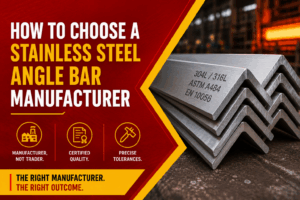
317L Stainless Steel is also known as: UNS S31703 · DIN 1.4438 · EN 10088-3 X2CrNiMo18-15-4 · AISI 317L · JIS SUS317L. Always verify the standard when sourcing internationally.
The “L” designation signals a low carbon content ≤ 0.030% — a critical specification that prevents carbide precipitation in the heat-affected zone (HAZ) during welding, eliminating the need for post-weld annealing in most fabrication scenarios. This is what separates 317L from the base Grade 317 (UNS S31700) in weld-intensive projects.
2. Chemical Composition & The “L” Advantage Explained
The chemistry of 317L stainless steel is tightly controlled by ASTM A240 and ASME SA-240. Understanding each alloying element helps engineers and procurement teams specify the right grade for demanding environments.
| Element | 317L (UNS S31703) | Role in Performance |
|---|---|---|
| Carbon (C) | ≤ 0.030% | Low carbon = no sensitization during welding. The “L” advantage. |
| Chromium (Cr) | 18.0 – 20.0% | Passive oxide layer. Corrosion & oxidation resistance. |
| Nickel (Ni) | 11.0 – 15.0% | Austenitic stability, formability, toughness at low temperatures. |
| Molybdenum (Mo) | 3.0 – 4.0% | Pitting & crevice corrosion resistance. The key differentiator over 316L. |
| Manganese (Mn) | ≤ 2.0% | Austenite stabilizer, deoxidizer. |
| Silicon (Si) | ≤ 0.75% | Oxidation resistance at high temperatures. |
| Phosphorus (P) | ≤ 0.045% | Controlled for weldability. |
| Sulfur (S) | ≤ 0.030% | Controlled for ductility and surface quality. |
| Nitrogen (N) | ≤ 0.10% | Strengthens austenite. Enhances pitting resistance. |
The low carbon ceiling of ≤ 0.030% in 317L is not merely a specification — it is a fabrication insurance policy. It means the alloy can be welded in multi-pass, heavy-thickness applications without chromium carbide precipitation destroying the HAZ’s corrosion resistance.
— Ambica Steels Technical Metallurgy Team
3. 317L vs 316L: Key Differences That Matter in the Field
This is the comparison that procurement engineers and materials specialists search for most. Both are austenitic, low-carbon, molybdenum-bearing grades — but the differences are significant enough to warrant an upgrade in aggressive service conditions.
| Property | 316L (UNS S31603) | 317L (UNS S31703) | Verdict |
|---|---|---|---|
| Molybdenum Content | 2.0 – 3.0% | 3.0 – 4.0% | 317L wins |
| Nickel Content | 10.0 – 14.0% | 11.0 – 15.0% | 317L wins |
| PREN Value (typical) | ~24–26 | ~28–33 | 317L wins |
| Sulfuric Acid Resistance | Moderate | Superior | 317L wins |
| Chloride Pitting Resistance | Good | Excellent | 317L wins |
| Weldability (L grade) | Excellent | Excellent | Tie |
| Cost vs 304 | Higher | Highest (Mo premium) | 316L cheaper |
| FGD System Suitability | Marginal | Proven industry standard | 317L wins |
The higher molybdenum and nickel content comes at a cost premium over 316L — but in environments involving sulfur dioxide scrubbing, chlorinated process streams, or mixed acid baths, the total cost of ownership for 317L is significantly lower due to reduced maintenance, fewer replacements, and longer service life.
4. Understanding the PREN Value of 317L
The Pitting Resistance Equivalent Number (PREN) is a calculated index used to compare alloys’ resistance to localized pitting corrosion in chloride-containing environments. The formula is:
PREN = %Cr + 3.3 × %Mo + 16 × %N
For 317L with typical values (Cr=19%, Mo=3.5%, N=0.07%):
PREN ≈ 19 + (3.3 × 3.5) + (16 × 0.07) = 19 + 11.55 + 1.12 ≈ 31.7
A PREN above 28 is generally considered to provide strong resistance to chloride pitting in process environments. Grade 316L typically achieves a PREN of 24–26, while 317L achieves 28–33 — putting it firmly in the category suitable for acidic chloride-rich environments like bleach plant liquors, acid mine drainage, and FGD condensates.
5. Mechanical & Thermal Properties of Grade 317L Stainless Steel
Mechanical Properties (Annealed Condition — ASTM A276)
| Property | Value | Unit |
|---|---|---|
| Tensile Strength (min) | 515 | MPa |
| Yield Strength 0.2% Proof (min) | 205 | MPa |
| Elongation (min in 50mm) | 40 | % |
| Hardness (max) | 217 | HBW |
| Elastic Modulus | 193 | GPa |
| Poisson’s Ratio | 0.27 – 0.30 | — |
Physical & Thermal Properties
| Property | Value | Unit |
|---|---|---|
| Density | 8.0 | g/cm³ |
| Melting Range | 1375 – 1400 | °C |
| Thermal Expansion (0–100°C) | 16.0 | µm/m·°C |
| Thermal Conductivity (100°C) | 13.5 | W/m·K |
| Specific Heat Capacity | 500 | J/kg·K |
| Electrical Resistivity | 0.74 | µΩ·m |
| Magnetic Permeability (annealed) | 1.02 | — |
317L maintains higher creep strength, stress-to-rupture values, and tensile strength at elevated temperatures compared to 304 and 316L — making it suitable for heat exchangers, condensers, and high-temperature chemical reactors where structural integrity under thermal cycling is critical.
6. Industry Applications: Where 317L Outperforms Everything Else
The combination of high molybdenum, low carbon, and elevated nickel positions 317L as the alloy of choice in a distinct set of demanding industrial environments. Here are the primary sectors where it is specified:
Flue Gas Desulfurization (FGD)
FGD scrubbers in coal and oil-fired power plants produce highly acidic, chloride-rich condensate. 317L is the industry-proven choice for absorbers, stack liners, dampers, and ductwork where carbon steel fails in weeks.
Chemical & Petrochemical Processing
Reactors, storage tanks, piping, and heat exchangers handling sulfuric acid, hydrochloric acid, phosphoric acid, and mixed acid environments. Widely used in fertilizer and dye manufacturing.
Pulp & Paper Industry
Digesters, bleach washers, and kraft process equipment exposed to chlorine dioxide, sodium hypochlorite, and sulfurous acid liquors — where 316L shows rapid pitting failure.
Power Generation
Steam condensers, heat exchangers, and cooling water systems in fossil fuel and nuclear plants benefit from 317L’s combined high-temperature strength and corrosion resistance.
Oil & Gas Upstream/Downstream
Offshore platform components, sour gas pipelines, and refinery processing equipment exposed to H₂S, CO₂, and chloride-rich brines. 317L Stainless Steel is specified under NACE MR0175 environments.
Pharmaceutical & Food Processing
Vessels and piping handling organic acids (acetic, citric, tartaric, fatty acids) in pharmaceutical API production, food-grade processing, and beverage manufacturing.
Textile Industry
Dyeing machines, storage tanks, and piping exposed to acid dyestuffs, bleaching solutions, and acetylating mixtures where sustained corrosion resistance is critical.
Marine & Coastal Infrastructure
Offshore structures, desalination pre-treatment equipment, and coastal industrial facilities where seawater chloride exposure demands a higher PREN than 316L can provide.
7. Weldability & Fabrication of 317L Stainless Steel
One of the most practical advantages of the “L” grade classification is its direct impact on weldability. With carbon restricted to ≤ 0.030%, 317L can be welded without the risk of sensitization — the phenomenon where chromium carbides precipitate at grain boundaries in the heat-affected zone (HAZ), destroying local corrosion resistance.
- Compatible welding processes: GTAW (TIG), GMAW (MIG), SMAW (Stick), SAW (Submerged Arc) — all standard fusion welding methods are applicable.
- Recommended filler metal: ER317L (AWS A5.9) for TIG and MIG. Use slightly over-alloyed filler in heavy-section welds to account for dilution.
- Post-weld heat treatment: Generally not required for L-grade due to low carbon. Solution annealing at 1040–1080°C followed by rapid water quench is only needed for critical elevated-temperature service.
- Work hardening: 317L work-hardens at a moderate rate. Low cutting speeds and consistent feeds minimize the tendency to work harden during machining.
- Non-magnetic in annealed condition: May become slightly magnetic after cold working or welding — this is normal and does not indicate a property change.
8. Product Forms Available from Ambica Steels
Ambica Steels supplies Grade 317L (UNS S31703) conforming to ASTM A276, ASTM A484, ASME SA-276, and EN 10088-3 in the following product forms:
| Product Form | Standards | Link |
|---|---|---|
| Bright Round Bars | ASTM A276 / EN 10088-3 | View Product → |
| Precision Round Bars | ASTM A276 / h9/h11 tolerance | View Product → |
| Hexagon Bars | ASTM A276 | View Product → |
| Square Bars | ASTM A276 | View Product → |
| Flat Bars (HRAP) | ASTM A484 | View Product → |
| Hot Rolled Bars | ASTM A276 | View Product → |
| Forged Bars | ASTM A484 / ASME SA-484 | View Product → |
Warehousing available from New Delhi, Maharastra and Gujrat— enabling fast dispatch to customers across Asia, the Middle East, and Europe. All material supplied with Mill Test Certificates (MTCs) to EN 10204 3.1 standard.
Ready to Source Grade 317L Stainless Steel ?
Ambica Steels supplies 317L (UNS S31703) bars, flat bars, hexagons, and forged bars from stock in New Delhi and Maastricht. Mill Test Certificates (3.1 MTC) supplied with every order.