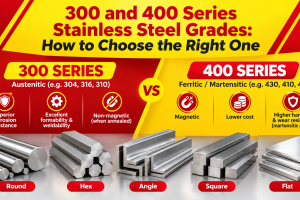
Stainless steel general purpose wire is cold drawn stainless wire that manufacturers straighten and cut into dowels, straight pins, hinge pins and similar parts. For most dowels and pins, grade 304 is the standard choice. Choose 316 for chlorides, marine or chemical exposure, 430 where a magnetic pin is needed, and 410 where the pin must be hardened by heat treatment.
If your part needs a formed head, such as a rivet or a headed pin, use cold heading wire instead. Ambica Steels supplies general purpose wire in austenitic, ferritic, duplex and custom grades.
Key Takeaways
- General purpose wire suits straight, cut-to-length parts. Cold heading wire suits parts with formed heads.
- Grade drives corrosion resistance. 304 is the default, 316 is the upgrade for harsh environments.
- Surface condition matters: bright (cold drawn) wire gives a clean, tight-tolerance finish, while annealed wire is softer and easier to form.
- A pin can only be as accurate as its wire, so specify diameter, tolerance and straightness up front.
What Is Stainless Steel General Purpose Wire?
It is wire drawn cold through dies to a controlled diameter, made from stainless steel grades chosen for corrosion resistance and strength. It is not made for one narrow job, which is why it is called general purpose. The same wire can become a dowel pin, a hinge pin, a fence component or a wire form. For a broader introduction, see our post What Is Stainless Steel General Purpose Wire and Where Is It Used.
What Are Wire Dowels and Pins?
A dowel is a solid cylindrical pin that fits into matching holes in two parts to keep them aligned. A pin is the wider family: dowel pins, straight pins, hinge pins, retaining pins and cotter-type wire pins. Made from stainless wire, they resist rust in damp, wash down, outdoor and food-contact settings where plain carbon steel would corrode.
How a Wire Becomes a Dowel or Pin
- Grade and condition selected: for example 304 bright, or 316 annealed.
- Cold drawing: wire is drawn through dies to the target diameter and finish.
- Straightening and cutting: wire is straightened and cut to length.
- End finishing: ends are chamfered or rounded for easy insertion.
- Optional processing: polishing, passivation or, for 410, hardening.
- Inspection: diameter, length and straightness are checked.
Which Stainless Grade Should You Choose?
| Grade | Family | Best for | Watch out for |
|---|---|---|---|
| 304 / 304L | Austenitic | Default for dowels and pins in normal environments | Limited resistance to chlorides |
| 302 | Austenitic | General wire forms and pins | Similar to 304; confirm the property you need |
| 316 / 316L | Austenitic | Marine, chemical and chloride exposure | Higher cost than 304 |
| 430 | Ferritic | Magnetic pins, mild environments, lower nickel cost | Lower corrosion resistance than 304 |
| 410 | Martensitic | Pins that must be hardened for wear or shear | Needs heat treatment; less corrosion resistant |
Ambica Steels also lists 316Ti among its wire grades. Ask for the grade that matches your end use rather than defaulting to the most common one.
Bright or annealed?
- Bright (cold drawn): clean, smooth finish and tight diameter control. Good for pins that go straight into reamed or drilled holes.
- Annealed: softer and more ductile. Choose it when you will bend or form the wire after cutting.
General Purpose Wire vs Cold Heading Wire
| General purpose wire | Cold heading wire | |
|---|---|---|
| Typical parts | Dowels, straight pins, wire forms | Screws, bolts, rivets, headed pins |
| How it is used | Straightened and cut or bent | Forged cold into a head in a header machine |
| Priority | Dimensional accuracy, finish, corrosion resistance | Formability and consistency in heading |
If you are making woodworking dowels and pins, read our guide on cold heading wire for woodworking dowels and pins. Learn more about the cold heading wire range.
Where Are Stainless Wire Dowels and Pins Used?
- Food and beverage equipment: corrosion resistance and easy cleaning
- Marine and coastal hardware: 316 pins resist salt exposure
- Medical and laboratory equipment: clean, non-rusting alignment parts
- Furniture, fittings and joinery: hinge pins and alignment pins
- Machinery, tooling and automotive: locating and retaining pins
- Construction and fencing: pins and wire components for outdoor use
How to Specify Wire for Dowels and Pins
- Grade: 304, 316, 430 or 410, based on environment and magnetic needs.
- Condition: bright or annealed.
- Diameter and tolerance: state both. The tighter the fit, the tighter the tolerance.
- Length and straightness: state the cut length and acceptable straightness.
- Finish and ends: bright, polished or passivated; chamfered or rounded ends.
- Quantity and packing: coil, spool or straight lengths.
Ambica Steels general purpose wire range: diameter range [add], tolerance [add], conditions bright and annealed, packing [add]. Replace the brackets with your verified figures before publishing.
Frequently Asked Questions
What is general purpose wire used for?
Manufacturers use general purpose wire to make straight, cut-to-length or bent parts such as dowels, pins, wire forms, fencing and light structural components.
Which stainless steel is best for dowel pins?
Grade 304 is the standard choice for most dowel pins. Grade 316 is better for marine, chemical or chloride-rich environments, and 410 is used where the pin must be hardened.
Are stainless steel dowel pins magnetic?
Grades 304 and 316 are largely non-magnetic in the annealed state, though cold working can add slight magnetism. Grades 430 and 410 are magnetic.
What is the difference between general purpose wire and cold heading wire?
General purpose wire is for straight or bent parts. Cold heading wire is made to be forged into heads in a header machine, as in screws, bolts and rivets.
Should I choose bright or annealed wire for pins?
Choose bright wire for a clean finish and tight diameter control. Choose annealed wire if the pin will be bent or formed after cutting.
Can I order custom grades?
Ambica Steels supplies general purpose wire in austenitic, ferritic, duplex and custom grades. Contact the team with your requirements.
Conclusion
Picking the right stainless grade, condition and tolerance for your dowels and pins prevents corrosion failures, loose fits and rework. Start with 304, move to 316 for harsh environments, and use cold heading wire when your part needs a head.
Need stainless steel general purpose wire for dowels and pins? View the SS General Purpose Wire page or request a quote with your grade, diameter, condition and quantity.