What Are Stainless Steel Profiles?
— Technical Note, Ambica Steels Engineering Team
What unites all stainless steel profiles is the alloy itself: a minimum of 10.5% chromium content in the steel, which forms a passive oxide layer that gives the material its signature corrosion resistance. Beyond that baseline, differing alloying additions — nickel, molybdenum, titanium, nitrogen — create the dozens of grades that make stainless steel so versatile across industries.
For buyers and specifiers in India, understanding which profile shape maps to which application requirement is the first and most consequential decision in any procurement. Specifying a round bar where a flat bar is needed — or an angle section where a hex bar is required — creates fabrication complexity, cost overruns, and performance shortfalls that are avoidable with the right guidance upfront.
Types of Stainless Steel Profiles
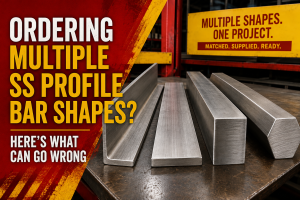
Ambica Steels manufactures five core stainless steel profile types — each with a distinct cross-sectional form and a well-defined role across industries. Understanding these five profiles is the foundation of any sound specification decision.
Round Bar Profiles
Circular cross-section manufactured by cold drawing or hot rolling. The most versatile profile type — machined into shafts, spindles, valve bodies, pump components, and precision turned parts across automotive, aerospace, and general engineering.
Square Bar Profiles
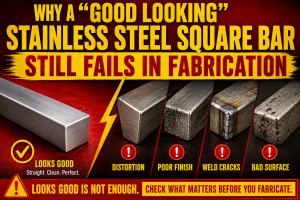
Equal four-sided section delivering a flat contact face on every side. Used in marine fittings, food machinery structural frames, architectural pillars, precision jigs, and applications where a defined flat bearing surface is required.
Flat Bar Profiles
Rectangular section with a high width-to-thickness ratio. The preferred choice for structural brackets, load-spreading supports, wall cladding reinforcements, decorative architectural trim, and any application where a broad, stable surface matters.
Hexagonal Profiles
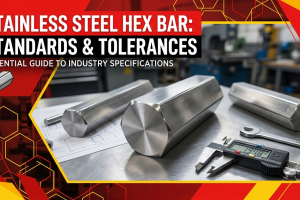
Six-sided section enabling direct spanner grip without adapters. Essential for fastener blanks, valve stems, pump shafts, and instrumentation fittings where rotational force must be applied cleanly.
Angle Profiles
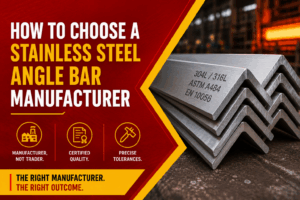
L-shaped cross-section available in equal and unequal leg configurations. The structural workhorse of pharmaceutical plant frames, food-grade equipment, process machinery, and architectural corner details.
When evaluating metal profile options, the manufacturing method matters as much as the shape. Ambica Steels produces both cold-drawn and hot-rolled profiles: cold-drawn sections deliver tighter dimensional tolerances (h9–h11) and a bright, machine-ready surface; hot-rolled sections suit larger structural applications where tolerance is less critical than throughput and raw cost.
Key Grades for Profile Stainless Steel
Selecting the right grade is the highest-leverage decision in any profile stainless steel specification. Grade determines corrosion resistance envelope, mechanical property range, and machinability — and directly affects life-cycle cost. The table below covers the grades most commonly available as stainless steel profiles in India.
| Grade | Family | Key Alloying | Corrosion Level | Typical Profile Use |
|---|---|---|---|---|
| 304 / 304L | Austenitic | 18% Cr, 8% Ni | Good — general environments | Food equipment frames, architectural bars, general engineering profiles |
| 316 / 316L | Austenitic | 18% Cr, 10% Ni, 2% Mo | Excellent — chloride resistance | Marine profiles, chemical plant angles, pharmaceutical channels |
| 316Ti | Austenitic | 316 + Titanium stabiliser | Excellent — high temp stability | Heat exchanger tie bars, weld-intensive structural profiles |
| 321 | Austenitic | 18% Cr, 10% Ni, Ti | Good — sensitisation resistant | Exhaust profiles, aerospace structural members, jet engine components |
| 410 | Martensitic | 12% Cr | Moderate — requires surface protection | High-strength bars, pump shafts, fastener profiles in low-moisture environments |
| 430 | Ferritic | 17% Cr, low Ni | Good — moderate corrosion duty | Architectural sections, automotive trim profiles, appliance structural parts |
| 2205 | Duplex | 22% Cr, 5% Ni, 3% Mo | Superior — stress corrosion cracking resistant | Oil & gas downhole profiles, desalination plant bars, structural offshore sections |
| 17-4 PH | Precipitation Hardening | 17% Cr, 4% Ni, Cu | Good — very high strength | Aerospace fastener bars, pump shafts, precision bearing profiles |
One practical note for Indian buyers: L-grade variants (304L, 316L) carry lower carbon content, making them suitable for welded fabrications where sensitisation — carbide precipitation at grain boundaries — is a risk. When your stainless steel profile will be extensively welded on site, specifying the L-grade is not a premium, it is a necessity.
Industry Applications of Stainless Steel Profiles
The market for steel profiles in India is driven by simultaneous demand from infrastructure, process industries, food & beverage, and advanced manufacturing. Here is where stainless steel profiles do their most critical work.
01 — Pharma
Pharmaceutical & Cleanroom
Hygienic angle and flat bar profiles form equipment frames, rack systems, and wall reinforcements in sterile facilities where surface cleanability and zero contamination are non-negotiable. Grade 316L is the default specification, and cold-drawn bright finish meets GMP surface requirements without additional machining.
02 — Food & Bev
Food Processing
Conveyor side frames, mixing tank supports, and slaughter-floor structures all rely on stainless steel profiles. Their resistance to acidic cleaning agents and wash-down pressure makes them the only viable metal profile option in direct food-contact zones.
03 — Oil & Gas
Petrochemical & Offshore
Duplex and super-duplex profiles handle sour gas environments, saline water, and high pressures where standard austenitic grades would succumb to stress corrosion cracking within months of service.
04 — Construction
Architecture & Infrastructure
Stainless steel angle bars, flat bars, and square bars are increasingly specified in landmark buildings, coastal bridges, and urban transport infrastructure for their low maintenance life-cycle cost and premium aesthetic durability.
05 — Automotive
Automotive & EV
Exhaust profiles in 321 grade, battery housing structural bars for EV platforms, and precision-machined hexagonal profiles for fastener pre-forms are driving growing volumes in India’s automotive corridor.
06 — Water
Water & Desalination
India’s water infrastructure push — desalination plants, water treatment facilities, and pipeline frameworks — demands profile stainless steel that withstands chloride-heavy water chemistry over 25+ year service lives.
How to Choose the Right Stainless Steel Profile
There is no single best stainless steel profile. The right choice emerges from a structured evaluation of your specific application conditions. Use this decision framework as your starting checklist.
Step 1 — Define the operating environment
This is the most critical input. Chloride-rich environments (coastal, marine, swimming pools, saline water treatment) demand Grade 316 or duplex profiles. Elevated temperature service above 400°C shifts the specification toward 321 or 347. Purely atmospheric, non-chemical environments can often be served well by 304 — which is also more cost-efficient.
Step 2 — Determine mechanical load requirements
Identify whether the profile carries structural loads, transmits torque, or serves primarily as a casing or trim element. Structural members need to meet minimum yield strength and impact toughness criteria. Decorative profiles prioritise surface finish over mechanical properties. Fastener blanks require specific hardness ranges to achieve thread-forming performance.
Step 3 — Select the cross-section shape
- Round bars: Best for rotating shafts, spindles, and machined precision parts requiring a circular cross-section
- Hex bars: Best for fastener blanks, valve components, and any application requiring direct spanner or socket engagement
- Square bars: Best for marine fittings, food machinery frames, jig and fixture components, and architectural posts
- Flat bars: Best for structural brackets, equipment reinforcements, decorative trim, and any wide-surface load-spreading application
- Angle profiles: Best for structural frame joints, corner reinforcement, equipment skids, and L-bracket fabrications
Step 4 — Specify finish and tolerance class
Cold-drawn profiles deliver bright, smooth surfaces with h9–h11 dimensional tolerance — suitable for applications requiring close fits or hygienic finish. Hot-rolled profiles carry mill scale and wider tolerances but are cost-effective for large structural applications where finish is secondary. Polished or electropolished surfaces add cost but are mandatory in medical device and high-purity semiconductor applications.
Step 5 — Confirm applicable standards
Indian projects reference IS 6603, while many exports require ASTM A276, ASTM A484, EN 10088, or DIN standards. Specifying the standard upfront — rather than inferring equivalence — prevents supply-chain disputes at inspection and acceptance.
Quality Standards & Certifications for Stainless Steel Profiles
India’s leading stainless steel profile producers operate under internationally recognised quality frameworks. When evaluating a supplier, verify the following documents as a minimum:
- Mill Test Certificate (MTC) to EN 10204 3.1 or 3.2 — confirming chemical composition and mechanical properties from the heat of steel used
- Third-party inspection reports — from agencies such as Bureau Veritas, SGS, or Lloyd’s Register where project specifications require independent verification
- PMI (Positive Material Identification) test reports — critical for high-alloy grades (duplex, super-duplex, 17-4 PH) to confirm alloying content at the bar level
- Surface finish certification — Ra value reports for machined or electropolished profiles specified for hygienic or precision applications
- NABL-accredited test lab reports — for projects tendered under Indian public procurement frameworks
- ISO 9001 and IATF 16949 certifications — for manufacturer quality management systems, essential for automotive supply chain qualification
Dimensional conformance — straightness, cross-sectional tolerance, and length tolerance — should be confirmed against the applicable standard for each specific profile type, since tolerances vary between round bars (ASTM A276), flat bars (ASTM A484), and structural shapes.
Stainless Steel Profiles from India: The Advantage
India has emerged as one of the world’s top stainless steel producers, with integrated mills, specialty re-rollers, and precision cold-drawing units spread across Maharashtra, Gujarat, and the southern industrial belt. For global buyers and domestic project developers alike, sourcing steel profiles from India offers a compelling combination of factors.
01 Integrated Production
India’s leading mills control alloy melting through to finished profile — ensuring traceability from heat to bar and consistent chemistry across large order quantities.
02 Grade Breadth
Austenitic, ferritic, martensitic, duplex, and precipitation-hardening grades are available ex-stock or in short lead times — an advantage over many regional markets.
03 Cost Competitiveness
India’s domestic nickel and chromium processing capacity, combined with lower manufacturing overheads, consistently delivers competitive landed costs versus European and East Asian origins.
04 Export Infrastructure
Major SS profile exporters in India are linked to JNPT, Mundra, and Chennai ports, supporting containerised and break-bulk export to Middle East, Europe, Southeast Asia, and the Americas.
05 Technical Support
Established Indian SS manufacturers offer pre-order metallurgical advisory, custom profile drawing review, and post-supply failure analysis — a level of service that commodity traders cannot match.
06 Five Profile Range
Round, hex, square, flat, and angle profiles under one roof — buyers consolidate vendor relationships, simplify logistics, and maintain consistent material traceability across all profile types from a single certified source.
— Export Industry Insight, 2025
Frequently Asked Questions
The most common questions buyers ask when specifying or sourcing stainless steel profiles and metal profile products from India.
Stainless steel bars — round, square, flat, and hex — are individual profile types within the broader stainless steel profile family. The term “profile” encompasses any long-form section with a defined cross-section; angle profiles are also in this family. At Ambica Steels, all five — round bars, hexagonal bars, square bars, flat bars, and angle profiles — are manufactured and certified under the same quality framework, with mill traceability across every profile type.
For coastal environments in India — especially within 5 km of the shoreline — Grade 316L is the standard specification due to its molybdenum content that resists chloride-induced pitting. For structures in the tidal or splash zone, duplex Grade 2205 provides an even higher margin of corrosion safety and better strength-to-weight ratio, reducing the overall tonnage of steel needed.
Ambica Steels manufactures stainless steel round bars from small precision diameters up to large-section forging billets, and hexagonal bars across a wide across-flats range to suit fastener and machining requirements. For exact size availability by grade and profile type, the product pages or the sales team can confirm current stock dimensions and lead times for non-stock sizes.
Indian manufacturers typically supply profiles in as-drawn (bright), centreless-ground, polished (240–400 grit), and electropolished finishes. The appropriate finish depends on the application: bright drawn for machined parts, polished for hygienic or architectural use, and electropolished for pharmaceutical or food-contact applications where bacterial adhesion must be minimised.
At a minimum, request a Mill Test Certificate to EN 10204 3.1 (or 3.2 if your project requires third-party witnessed tests). For high-alloy grades (duplex, 17-4 PH), require PMI test reports. For projects under ISO or FDA oversight, ask for the mill’s ISO 9001 certificate and any applicable process qualifications. Third-party inspection at the mill is advisable for large-value or critical-safety orders.
Grade 316L is generally preferred for food processing profiles, especially where cleaning agents containing chlorine or acidic solutions are used routinely. Grade 304 is acceptable for dry or mildly wet food environments where direct chemical exposure is limited. The L-suffix in both grades is important for welded fabrications to prevent sensitisation at heat-affected zones.
Source Stainless Steel Profiles from India’s Trusted Manufacturer
Ambica Steels manufactures stainless steel round bars, hexagonal bars, square bars, flat bars, and angle profiles across grades from 304 to duplex 2205 — all with full mill certification and export capability to 40+ countries.