Procurement mistakes in steel sourcing are expensive — not because of price alone, but because wrong dimensions, incorrect tolerances, or mismatched grades can halt production lines, trigger rejections, and delay delivery cycles. If you are a purchase manager, design engineer, or sourcing head responsible for procuring stainless steel hex bar in bulk, this guide is written specifically for you. It goes beyond general product descriptions and addresses the dimensional, grade, and specification decisions that matter at the procurement stage.
Why Hex Bar Geometry Itself Is a Procurement Decision
Most buyers focus on grade and price. Very few ask the right question first: Is the geometry of the hex bar aligned with the machining or fabrication process downstream?
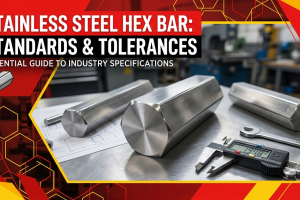
A stainless steel hexagon bar (also referred to as a hex rod or hexagon rod) has six equal flat sides measured across flats (A/F). This is not merely a shape preference — it directly determines:
- How the bar feeds into a CNC lathe or screw machine
- How much material is wasted during machining
- Whether standard tooling can be used or custom tooling is required
- How torque is transferred in assembled components
When your design team specifies a “hex rod” without stating the across-flats (A/F) dimension and the tolerance class, you are setting up your procurement and production teams for friction at the inspection stage.
Stainless Steel Hex Bar Dimensions: The Technical Reference B2B Buyers Need
Measuring Stainless Steel Hex Bar — Across Flats vs Across Corners
The across flats (A/F) measurement is the standard reference dimension for all hex bars. It is the distance between two parallel flat sides. This is what your supplier quotes. This is what you specify on the drawing.
The across corners (A/C) is a derived value. It is approximately 1.1547 times the A/F dimension. It helps in checking bar fit in socket tooling, but it should not be used as the ordering reference.
Formula:
Across Corners (A/C) = A/F × (2 / √3) ≈ A/F × 1.1547
For procurement purposes, always confirm with your supplier which dimension their tolerance applies to — A/F is the standard, but verify it.
Standard Hex Bar Dimensions — Size Range at Ambica Steels
At Ambica Steels, stainless steel hex bars are available in a size range of 12 mm to 65 mm across flats. This range covers:
| Application Type | Typical A/F Size Range |
|---|---|
| Precision fasteners and bolts | 12 mm – 24 mm |
| Shafts, couplings, connectors | 20 mm – 40 mm |
| Heavy-duty structural components | 40 mm – 65 mm |
| High-torque industrial fittings | 30 mm – 65 mm |
For the complete size chart and available inventory, visit: Stainless Steel Hex Bars — Ambica Steels
Tolerance Classes for Stainless Steel Hex Bar — h10 and h11
This is where most B2B procurement errors happen. Tolerance class determines how precisely the bar dimensions are controlled. For stainless steel hexagon bars, the two most commonly specified tolerance classes are:
h11 tolerance — Standard commercial tolerance. Suitable for general engineering, structural applications, and components where slight dimensional variation is acceptable in the machining process.
h10 tolerance — Tighter tolerance band. Preferred when the bar feeds directly into automatic screw machines, CNC turning centres, or high-speed fastener manufacturing lines where consistent bar diameter ensures predictable tool engagement.
Practical guidance for procurement:
If your downstream process is manual machining or fabrication, h11 is adequate and usually more economical.
If your process involves automatic bar feeders, Swiss-type lathes, or close-tolerance fastener production, specify h10 from the outset — do not accept h11 and attempt to compensate at the machine.
Specifying the wrong tolerance class leads to bar slippage in chucks, inconsistent thread quality, and higher rejection rates. Fix this at the procurement stage, not the production stage.
Grade Selection Matrix for Stainless Steel Hex Bar — A Procurement Reference
Different industries have different corrosion, temperature, and strength requirements. Here is a grade reference matrix designed for sourcing decisions:
| Grade | Key Property | Best For | Avoid When |
|---|---|---|---|
| SS 304 | General corrosion resistance, good formability | Food industry fittings, general fasteners, indoor structural | Marine or chloride-rich environments |
| SS 316 | Molybdenum-enhanced corrosion resistance | Chemical processing, marine hardware, offshore equipment | High-temperature applications above 870°C |
| SS 410 | High hardness, moderate corrosion resistance | Cutlery, surgical tools, fasteners needing hardness | Strongly acidic or saline environments |
| SS 416 | Free-machining, excellent machinability | High-volume CNC fastener production, automatic screw machines | Applications requiring high corrosion resistance |
| SS 17-4 PH | High strength + corrosion resistance | Aerospace, defence, high-stress shafts | Budget-sensitive, non-critical applications |
| SS 321 | High-temperature stability with titanium stabilisation | Heat exchangers, exhaust systems, furnace components | Low-temperature precision applications |
| SS 310 | Oxidation resistance up to 1100°C | Industrial furnaces, kiln furniture, thermal processing | Applications not involving elevated temperature |
Procurement note: For fastener manufacturing — the largest application segment for stainless steel hexagon bars — SS 304, SS 316, and SS 416 account for the majority of industrial volumes. If you are procuring for a fastener OEM, always align grade selection with the end-use environment of the fastener, not just the machining requirement.
The Across-Flats to Weight Calculation — For Quantity Estimation
When issuing purchase orders for stainless steel hex bar, quantity is typically specified in kilograms. However, design drawings specify size in millimetres. Below is the weight formula your team needs:
Weight per metre (kg/m) for stainless steel hex bar:
Weight (kg/m) = 0.00000680 × (A/F in mm)² × Density factor
For standard stainless steel (density ≈ 7.93 g/cm³):
Weight (kg/m) ≈ (A/F)² × 7.93 × 0.866 / 1000
Simplified reference values:
| A/F Size (mm) | Approx. Weight (kg/m) |
|---|---|
| 12 mm | 0.99 kg/m |
| 16 mm | 1.75 kg/m |
| 20 mm | 2.73 kg/m |
| 25 mm | 4.27 kg/m |
| 32 mm | 6.99 kg/m |
| 40 mm | 10.93 kg/m |
| 50 mm | 17.08 kg/m |
| 65 mm | 28.87 kg/m |
Use these values to calculate your total weight requirement from piece count and bar length. Most procurement teams receive requirements from production in piece-count terms and must convert to kilogram quantities for the purchase order.
Five Procurement Checklist Points Before Issuing a PO for Hex Bar
After years of supplying B2B customers across industries, the following checklist represents the specification points most frequently missed at the purchase order stage:
1. A/F Dimension — Confirmed, not assumed
The drawing says “hex bar 25 mm.” Does it mean 25 mm A/F or 25 mm A/C? Confirm with your design team. Always order on A/F basis.
2. Tolerance Class — Stated explicitly
h10 or h11? If it is not stated in your PO, the supplier may ship to the wider tolerance. This causes shop floor rejection.
3. Grade and Certification
State the grade (e.g., AISI 316 / EN 1.4401). Specify whether you require a Mill Test Certificate (MTC) — most industrial buyers should. For regulated industries (pharma, food, defence), also specify the certification standard (e.g., EN 10204 3.1 or 3.2).
4. Surface Finish
Bright finish (cold drawn) or hot rolled (as-rolled, scaled surface)? Cold drawn gives tighter tolerances and better surface quality. Hot rolled is used when bars will be further machined with high stock removal.
5. Bar Length
Standard lengths are typically 3 to 6 metres. Random lengths reduce cost but may not suit automatic bar feeders requiring uniform lengths. Specify fixed lengths if your production process demands it.
Why B2B Buyers Choose Ambica Steels for Stainless Steel Hex Bar
Procurement decisions in industrial steel are not just about the product — they are about reliability, consistency, and technical support across the supply chain. Here is what differentiates an industrial-grade hex bar supplier from a commodity trader:
- Manufactured to international standards — EN, ASTM, DIN, JIS
- Available in a full size range — 12 mm to 65 mm across flats
- Multiple grades in stock — 304, 316, 410, 416, 321, 310, 17-4 PH, and more
- Mill Test Certificates provided with every lot
- Consistent tolerances — suitable for CNC and automatic machining
- Technical support — grade selection and dimension advisory before order placement
Ambica Steels operates its own manufacturing facility with in-house quality controls, which means traceability from melt to delivery — a requirement for regulated industries.
Explore the full product range, available sizes, and request a quote:
👉 Stainless Steel Hex Bar — Ambica Steels
Related Reading for Your Technical and Procurement Teams
Before finalising your hex bar specification, your team may also find these resources useful:
- Why Stainless Steel Hex Bar Is Preferred for Fasteners and Shafts
- Hex Bar for Machining Applications
- SS Hex Bar Buying Guide
- Stainless Steel Hex Bar for the Automotive Industry
Summary — What Your Procurement Team Should Take Away
Procuring stainless steel hex bar for industrial applications is a specification-led decision, not just a price-led one. The dimension (A/F), tolerance class (h10/h11), grade, surface finish, and certification together define whether your production runs smoothly or generates rejection costs downstream.
Work with a manufacturer who understands these requirements and supports you through the specification process — not just the transaction.
For industrial quantities, standard or custom sizes, and grade-specific technical data, reach out to Ambica Steels directly through the hex bar product page:
👉 https://www.ambicasteels.com/stainless-steel-products/hex-bars