Stainless steel welding looks straightforward until you’re standing in front of a supplier’s catalog trying to decide between ER308L, ER316L, and ER309L — and whether TIG or MIG is even the right process for the job. Get the wire selection wrong, and the consequences show up later: pitting corrosion in a food processing tank, cracked welds on a marine railing, or a joint that simply doesn’t match the strength of the base metal.
Moreover, filler wire selection isn’t minor; it shapes weld quality, corrosion resistance, strength, and the final finish. With multiple wire grades and two dominant welding processes to choose from, it’s easy to see why so many fabricators, procurement teams, and maintenance engineers get stuck at this decision point.
Additionally, this guide outlines stainless steel welding wire fundamentals, TIG and MIG welding, common wire grades, and a selection framework. Additionally, a general industry rule is that filler wire should match the base metal and application demands.
Understanding Stainless Steel Welding Wire
What Is Stainless Steel Welding Wire?
Stainless steel welding wire — also called filler wire or filler metal — is the consumable material added during welding to join two pieces of stainless steel together. As the wire melts into the weld pool, it fuses with the base metal to form a continuous, structurally sound joint.
Two filler wire formats dominate stainless steel fabrication:
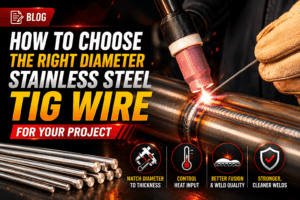
- TIG filler wire — supplied as straight rods, fed manually into the weld pool
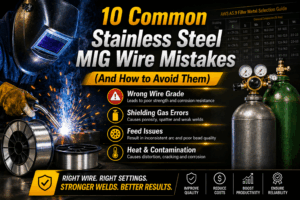
- MIG filler wire — supplied as a continuous spool, fed automatically through the welding gun
Both types come in a range of grades formulated to match specific stainless steel alloys and service conditions, which is why understanding the underlying metallurgy matters just as much as understanding the welding process itself.
Why Stainless Steel Requires the Right Filler Metal
Stainless steel isn’t a single material — it’s a family of alloys, each with a different chemical composition and performance profile. Using a mismatched filler wire can undermine the very properties that make stainless steel valuable in the first place. Four factors consistently come up in guidance on this topic:
- Material compatibility — the filler wire’s alloy content needs to align with the base metal to avoid weak or brittle welds
- Corrosion resistance — the wrong wire can create a weld zone that’s more vulnerable to rust or pitting than the surrounding metal
- Mechanical strength — filler wire contributes directly to the joint’s load-bearing capacity
- Weld appearance — for visible or cosmetic applications, wire selection affects finish quality and consistency
In short: the base metal and the filler wire need to work together, not just physically bond.
TIG vs. MIG Welding for Stainless Steel
Before selecting a wire grade, it’s worth settling on the welding process, since wire form and technique are closely tied together.
TIG Welding
TIG (Tungsten Inert Gas) welding is widely recognized for its precision and control. It’s the process of choice when a clean, high-quality finish matters more than speed. Key advantages include:
- Precision — fine control over heat input and weld pool
- Clean welds — minimal spatter and a smooth, refined bead
- Thin materials — well suited to lighter-gauge stainless steel that’s prone to warping
- Cosmetic finish — ideal for visible welds on architectural, food-grade, or decorative applications
MIG Welding
MIG (Metal Inert Gas) welding trades some precision for speed and efficiency, making it the preferred choice for high-volume or heavier fabrication work. Its strengths include:
- Speed — significantly faster than TIG for long weld runs
- Productivity — well suited to production environments and larger projects
- Thicker materials — handles heavier gauge stainless steel efficiently
- Continuous wire feed — reduces downtime compared to manually fed TIG rods
TIG vs. MIG Comparison Table
| Feature | TIG | MIG |
| Weld Quality | Very high, refined finish | Good, slightly less precise |
| Speed | Slower, more controlled | Faster, higher output |
| Learning Curve | Steeper, requires skill | Easier to learn |
| Productivity | Lower for large-scale runs | Higher for large-scale runs |
| Best Applications | Thin materials, cosmetic and precision welds | Thicker materials, high-volume fabrication |
How to Choose the Right Stainless Steel Welding Wire
With the fundamentals covered, here’s a practical five-step framework for narrowing down your wire selection.
Step 1 – Identify the Stainless Steel Grade
Start with the base metal. The filler wire should closely match — or intentionally complement — the grade of stainless steel being welded. This is the single most important compatibility check, since a mismatched wire can compromise corrosion resistance and mechanical properties from the outset [NS Arc].
Step 2 – Consider the Service Environment
Where will the finished weld actually live? The operating environment has a major influence on which wire grade will hold up over time:
- Indoor, low-corrosion settings
- Outdoor exposure to weather
- Marine or saltwater environments
- Chemical processing conditions
- Food processing and hygiene-sensitive settings
Step 3 – Choose the Welding Process
Decide between TIG and MIG based on material thickness, required finish quality, and production speed:
- TIG is preferable for thin materials, cosmetic finishes, and precision-critical joints
- MIG is preferable for thicker materials and higher-volume production runs
Step 4 – Select the Correct Wire Grade
Three wire grades come up repeatedly across industry guidance, each suited to distinct applications:
- ER308L — general-purpose welding of common austenitic stainless steels
- ER316L — improved corrosion resistance for demanding or corrosive environments
- ER309L — dedicated to joining dissimilar metals, particularly stainless-to-carbon steel
Step 5 – Verify Project Requirements
Before finalizing your choice, double-check the practical constraints of the project:
- Material thickness
- Required surface appearance
- Production volume and timeline
- Corrosion resistance needs specific to the application
Running through these five steps in order helps avoid the most common selection mistakes before they become expensive rework.
Stainless Steel Welding Wire Grade Comparison
ER308L
ER308L is the workhorse of stainless steel filler wire. It’s typically used for general-purpose fabrication and is compatible with common austenitic stainless steels such as 304 and 304L, making it a dependable default for a wide range of projects.
ER316L
ER316L is formulated for enhanced corrosion resistance, thanks to the addition of molybdenum. It’s the preferred choice for marine applications, chemical processing equipment, and other environments where standard 308L wire wouldn’t hold up as well over time.
ER309L
ER309L is purpose-built for joining dissimilar metals — most commonly stainless steel to carbon steel. Its higher alloy content helps bridge the metallurgical gap between the two materials, reducing the risk of cracking or weld failure at the transition point.
Quick Grade Comparison Table
| Grade | Best For | Advantages | Typical Applications |
| ER308L | General-purpose stainless welding | Reliable, widely compatible | Tanks, general fabrication, structural components |
| ER316L | Corrosive or marine environments | Superior corrosion resistance | Marine fabrication, chemical processing equipment |
| ER309L | Dissimilar metal joints | Bridges stainless-to-carbon steel | Transition joints, mixed-material fabrication |
Common Mistakes When Selecting Welding Wire
Even experienced fabricators can fall into a few predictable traps when selecting filler wire. Watching for these can save significant time and cost down the line.
Using the Wrong Wire Grade
Mismatching the wire grade to the base metal reduces corrosion resistance and can create material compatibility issues that only surface after the weld is put into service.
Ignoring the Service Environment
A wire that performs well indoors may fail prematurely outdoors, in marine conditions, or in chemical processing settings. Environmental exposure should factor into wire selection from the start, not as an afterthought.
Choosing Based Only on Price
Selecting the cheapest available wire without considering long-term performance is a common false economy. A lower upfront cost can be quickly outweighed by premature failure, corrosion, or costly rework — an important consideration even though it’s more of a general best practice than a rule spelled out explicitly in supplier literature.
Assuming One Wire Fits Every Project
Perhaps the most repeated piece of guidance across the industry: there’s no universal “best” wire. Selection should always be driven by the specific base metal, environment, and application at hand, not a one-size-fits-all default.
Application-Based Recommendations
Food Processing Equipment
Hygiene and corrosion resistance are non-negotiable in food-grade fabrication. Wire selection here typically favors grades that support a clean, corrosion-resistant finish suitable for repeated wash down and sanitation cycles.
Marine Fabrication
Saltwater exposure demands enhanced corrosion resistance, making ER316L a common choice for marine components, railings, and fittings.
Chemical Processing
Harsh chemical environments require careful attention to material compatibility, often pointing toward higher-alloy wire grades capable of withstanding aggressive exposure.
General Fabrication
For everyday structural and general fabrication work, cost-effectiveness and productivity often take priority, with ER308L and MIG welding frequently serving as the practical default combination.
Quick Wire Selection Matrix
For a fast, at-a-glance reference, this matrix combines base metal, environment, and process into a suggested starting point:
| Base Metal | Environment | Process | Suggested Wire |
| 304 | Indoor | TIG | ER308L |
| 316 | Marine | TIG | ER316L |
| Stainless + Carbon Steel | Fabrication | MIG/TIG | ER309L |
This matrix is a synthesis of the broader guidance covered above and is intended as a starting reference — always confirm final selection against your specific project requirements.
Frequently Asked Questions
Which stainless steel welding wire should I choose? It depends on your base metal, service environment, and application. As a starting point, ER308L works well for general-purpose 304/304L welding, ER316L for corrosive or marine conditions, and ER309L for dissimilar metal joints.
Is TIG better than MIG for stainless steel? Neither process is universally “better” — TIG offers superior precision and finish for thin materials and cosmetic work, while MIG offers greater speed and productivity for thicker materials and high-volume production.
Can ER316L replace ER308L? ER316L can often be used in place of ER308L thanks to its enhanced corrosion resistance, though it typically costs more. For standard indoor applications without significant corrosion risk, ER308L is usually sufficient.
When should ER309L be used? ER309L is specifically designed for joining dissimilar metals, most commonly stainless steel to carbon steel, where its higher alloy content helps prevent cracking at the transition.
How do I choose the right filler wire? Follow the five-step framework above: identify the base metal grade, consider the service environment, choose the appropriate welding process, select a compatible wire grade, and verify your project’s specific requirements before finalizing your choice.
Key Takeaways
- Always match the filler wire to the base metal grade
- Choose the welding process (TIG or MIG) based on material thickness and finish requirements
- Factor in the service environment indoor, outdoor, marine, chemical, or food-grade
- Prioritize corrosion resistance requirements over upfront cost alone
- Select the wire grade ER308L, ER316L, or ER309L based on the specific application
Final Thoughts
Choosing the right stainless steel welding wire comes down to a simple principle repeated throughout industry guidance: match the wire to the metal, the environment, and the job at hand [NS Arc, Shanti Metal, Viraj]. Skipping this step or choosing based on price alone is one of the most common ways fabricators end up with weld failures, corrosion issues, or costly rework.
Before your next project, take a moment to review the available stainless steel welding wire grades against your base metal and service conditions. And if you’re ever uncertain about compatibility or the right process for your application, it’s worth consulting a welding supplier or metallurgical expert, the right wire selection upfront pays off in weld quality, durability, and long-term performance.